Travel guide · Yuanjiajie
The Avatar mountains: Yuanjiajie and the Hallelujah peak
The floating Hallelujah Mountains of Pandora were inspired by Zhangjiajie’s sandstone pillars — and in 2010 the park renamed its most famous column “Avatar Hallelujah Mountain” to say so officially. This guide covers what Yuanjiajie actually is, how to get up (elevator or stairs), and how to walk the rim so the famous views arrive in the right order.
Short answer
Yuanjiajie is the plateau-rim area of Zhangjiajie National Forest Park where the Avatar scenery lives: the Avatar Hallelujah Mountain (renamed from the Southern Sky Column in January 2010), the First Bridge Under Heaven natural arch, and the Enchanting Terrace. It is covered by the park entrance ticket (about ¥225–230, park-set). Most visitors ride the ~326 m Bailong Elevator up (roughly ¥65–72 per ride) and give the rim circuit half a day. Mornings before the group wave are dramatically quieter.
Key facts
- Where
- Yuanjiajie area, Zhangjiajie National Forest Park (UNESCO Wulingyuan)
- The Avatar link
- The floating Hallelujah Mountains in Avatar were inspired by Zhangjiajie’s pillar scenery
- The renaming
- The Southern Sky Column was officially renamed “Avatar Hallelujah Mountain” in January 2010
- Getting up
- Bailong Elevator (~326 m, roughly ¥65–72 per ride) or a stair climb of well over an hour
- Key sights
- Avatar Hallelujah Mountain, First Bridge Under Heaven, Enchanting Terrace (Mihuntai)
- Ticket
- Included in the park entrance ticket, about ¥225–230 (prices set by the park)
- Crowds
- Heaviest roughly 09:30–14:00; queues at the elevator can reach 1–3 hours on peak days
- Time needed
- Half a day for the rim circuit
From Southern Sky Column to Avatar Hallelujah Mountain
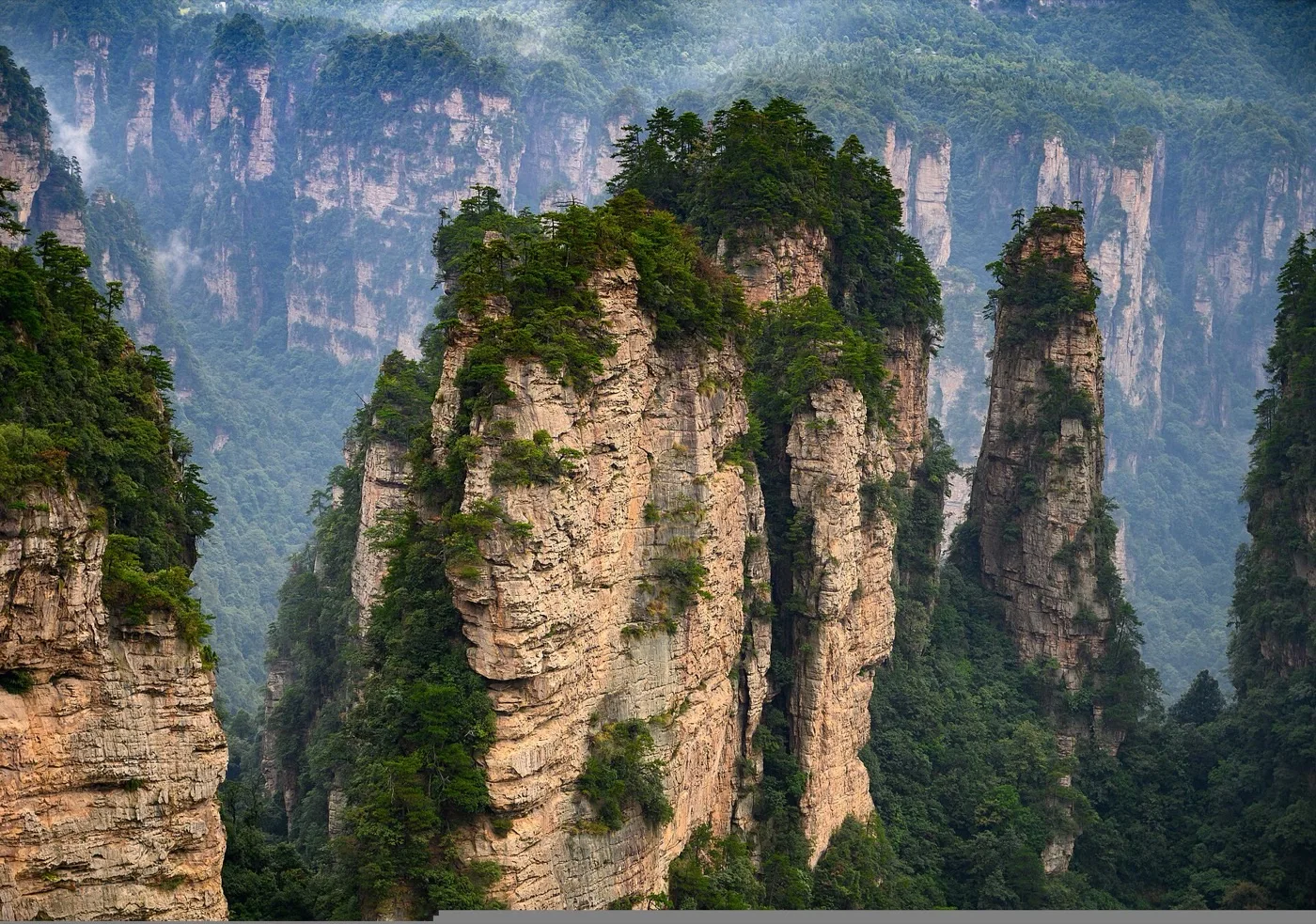
When Avatar released in 2009, audiences worldwide assumed the floating Hallelujah Mountains were pure digital invention. Locals in Zhangjiajie recognised them instantly. The film’s aerial-island scenery drew inspiration from Chinese landscape — and Zhangjiajie’s quartz-sandstone columns, photographed for years by production designers and travellers alike, are the real-world landscape most closely tied to it. In January 2010 the park made the connection official, renaming the 1,080-metre-class Southern Sky Column “Avatar Hallelujah Mountain” in a public ceremony.
Marketing? Partly, and locals will say so with a smile. But stand on the Yuanjiajie rim on a morning when the mist pools between the pillars and cuts their bases from view, and the columns genuinely appear to float. No other landscape on Earth does the trick so literally. The renaming stuck because the resemblance is honest.
The column itself is one pillar among more than 3,000 in the park — a freestanding quartz-sandstone tower with forest clinging to its ledges. What makes it the famous one is the viewing geometry: from the rim platform it stands separated from its neighbours, mid-air, exactly where a camera wants it.
What Yuanjiajie actually is
Yuanjiajie is not a single mountain but the edge of a high plateau — a walkable rim path running along the top of the cliffs, with viewing platforms hanging over the pillar fields below. That geography is why it delivers: you walk a mostly-level path from platform to platform while a 300-metre-deep stone forest scrolls past beneath you.
Beyond the Hallelujah platform, two stops define the circuit. The First Bridge Under Heaven is a natural rock arch spanning between two pillar tops — a bridge of solid sandstone left behind as the rock around it eroded away, with a vertigo-inducing drop beneath. The Enchanting Terrace (Mihuntai) is the wide-angle counterpart: a protruding platform with the broadest single view of the pillar field, and the classic spot for the layered-ridges-in-mist photograph.
The whole rim circuit is around two to three unhurried hours of walking, nearly all of it flat or gently stepped — one of the best effort-to-reward ratios in any national park anywhere.
Getting up: the Bailong Elevator vs the stairs

Most visitors ascend by the Bailong Elevator — a glass-fronted elevator rising about 326 metres up an exposed cliff face, listed by Guinness World Records as the world’s tallest outdoor elevator. The ride takes under two minutes, costs roughly ¥65–72 (park-set, subject to change), and the final seconds, when the car clears the rock and the pillar field bursts into view, are a genuine event. Queues are the price of fame: on peak days they can reach 1–3 hours, while early mornings and late afternoons are often walk-on.
The alternative is honest legwork: stair paths climb from the Golden Whip Stream valley up to the Yuanjiajie rim in roughly 1.5–2 hours of sustained steps through forest. It is a beautiful, quiet climb — and a serious one. A popular compromise: walk the stream, ride the elevator up, and save your knees for the rim itself.
Coming down, you do not need to reverse: buses on the plateau connect Yuanjiajie to the Tianzi cableway, so a one-way loop — elevator up, cableway down — is the standard smart route.
The rim circuit, in the right order
Direction matters more than most guides admit. The tour-group flow runs from the elevator station toward the Hallelujah platform mid-morning; walking the same loop in reverse, or simply starting an hour earlier, can mean having the First Bridge Under Heaven almost to yourself while the crowd is elsewhere.
A clean sequence for an early start: straight from the elevator to the Avatar Hallelujah Mountain platform first (it takes the earliest crowd hit), then the rim path to the First Bridge Under Heaven, then the Enchanting Terrace for the long views once the morning haze lifts. Photographers may want the reverse in the afternoon, when the light comes across the pillars instead of behind them.
- Avatar Hallelujah Mountain platform — the renamed column, best before 09:30
- First Bridge Under Heaven — natural sandstone arch between pillar tops
- Enchanting Terrace (Mihuntai) — the widest panorama of the pillar field
- Rim path between platforms — mostly flat, constant views, easy to underrate
Mist, light and the photograph you came for
The floating-mountain photograph needs partial mist: cloud low enough to hide the pillar bases, thin enough to leave the summits in sunlight. You cannot order that from a forecast, but you can play the odds — the effect is most common in the hours after rain, in early morning, and in spring and autumn generally. A grey forecast is often the best news a photographer here can get.
When the mist is total, do not waste the morning staring into white. This is exactly what the multi-day ticket is for: drop to Golden Whip Stream, which is at its best under cloud, and come back up when the rim clears. The mountains have been here 300 million years; they will wait an afternoon.
Seeing it with a local
Yuanjiajie is where a licensed private guide earns their keep most visibly: timing the elevator to skip the wave, walking the rim against the flow, reading the mist to call when the platforms will clear, and knowing the two or three unmarked spots where the view equals the famous platforms without the shoulder-to-shoulder crowd. Your guide also prepares the real-name tickets with your passport details in advance, so the day starts at a viewpoint rather than a ticket machine.
Frequently asked questions
Is Avatar Hallelujah Mountain really the mountain from Avatar?
The film’s floating Hallelujah Mountains are digital creations, but they were inspired by Zhangjiajie’s pillar scenery, and in January 2010 the park officially renamed the Southern Sky Column “Avatar Hallelujah Mountain” to mark the connection. It is the closest real-world landscape to Pandora you can stand in.
Do the mountains actually look like they are floating?
In the right mist, yes — genuinely. When low cloud hides the pillar bases, the forested summits appear suspended. On clear days they are “merely” a 3,000-tower stone forest, which is hardly a consolation prize.
How hard is the walking at Yuanjiajie?
Easy by mountain standards: the rim path is mostly flat with short stair sections. If you take the elevator up and the Tianzi cableway down, a visitor of average fitness — or a healthy senior — can do the full circuit comfortably.
How bad are the elevator queues?
Anywhere from zero to painful. On peak days queues can reach 1–3 hours; at opening time or late afternoon it is often walk-on. Going early is the single highest-value decision of the day.
Is the elevator scary?
It is fast, smooth and enclosed, with glass on the cliff side. Most people find it thrilling rather than frightening — and the exposed portion lasts well under a minute. Anyone truly uncomfortable can take the cableway-and-bus routing instead.
Sources
Planning a Zhangjiajie trip?
Send us your dates and questions on WhatsApp. A licensed local guide answers personally — usually within a few hours (08:00–22:00 China time).