Planning
Zhangjiajie weather — what it actually does, and what to pack for it
Zhangjiajie’s climate is humid subtropical with a mountain twist: warm wet summers, damp cold winters, generous rain that arrives in bursts, and mist that behaves like a resident. The city forecast is only half the story — the summits run their own weather. Here is the full picture, season by season, down to the shoes.
Short answer
Expect four real seasons: city summers around 25–35 °C and humid, winters around 0–10 °C and damp-cold, springs and autumns mostly 10–25 °C and ideal for walking. Rain concentrates from roughly April to August, usually as short heavy bursts, and mist is frequent all year — often gloriously so. The mountain tops typically feel 5–10 °C colder than the city with real wind, so layers matter in every season. Grippy shoes, a proper rain shell and one warm layer more than the city forecast suggests: that is the core packing rule.
Key facts
- Climate
- Humid subtropical — four distinct seasons, high moisture year-round
- Summer (Jun–Aug)
- Roughly 25–35 °C in the city, humid, with heavy showers and thunderstorms
- Winter (Dec–Feb)
- Roughly 0–10 °C, damp penetrating cold; occasional snow on the heights
- Spring / autumn
- Mostly 10–25 °C — the comfortable walking seasons
- Summit difference
- Typically 5–10 °C colder than the city, plus wind and cloud
- Rain pattern
- Concentrated April–August, usually short and heavy rather than all-day
- Mist
- Frequent in every season — often the best conditions the park offers
The climate in one paragraph
Zhangjiajie sits in northwestern Hunan at modest altitude — the city around 200 m, the park plateaus and summits roughly 1,000–1,500 m — in a humid subtropical zone fed by monsoon moisture. Translation: it is green because it is wet, dramatic because it is vertical, and photogenic because warm damp air meets cool sandstone towers and condenses into the mists the park is famous for. Annual rainfall is generous (on the order of 1,400 mm, concentrated in the warm months), humidity is high year-round, and no month is reliably dry.
The practical consequence is that Zhangjiajie weather planning is not about finding a rain-free window — there is none — but about packing so that rain costs you an hour, not a day, and knowing which sights shine in which sky.
Season by season
These are hedged planning ranges, not records — heat waves and cold snaps overshoot them in both directions. The stable pattern is the gap between rows two and three of each line: whatever the city is doing, the plateaus are doing a colder, windier version of it, usually with more cloud.
| Season | City temperatures (rough) | On the mountain | What it means for you |
|---|---|---|---|
| Spring (Mar–May) | 10–25 °C, showery | 5–18 °C, misty mornings | Prime walking; rain shell essential |
| Summer (Jun–Aug) | 25–35 °C, humid, storms | 18–26 °C, afternoon thunder | Early starts; summits pleasantly cooler |
| Autumn (Sep–Nov) | 8–28 °C, drying, clear spells | 5–20 °C, crisp, windy days | Best visibility; add a warm layer by Oct |
| Winter (Dec–Feb) | 0–10 °C, damp cold | −5–5 °C, ice and rare snow | Real winter kit; short days; magic after snow |
Rain and mist: how they actually behave
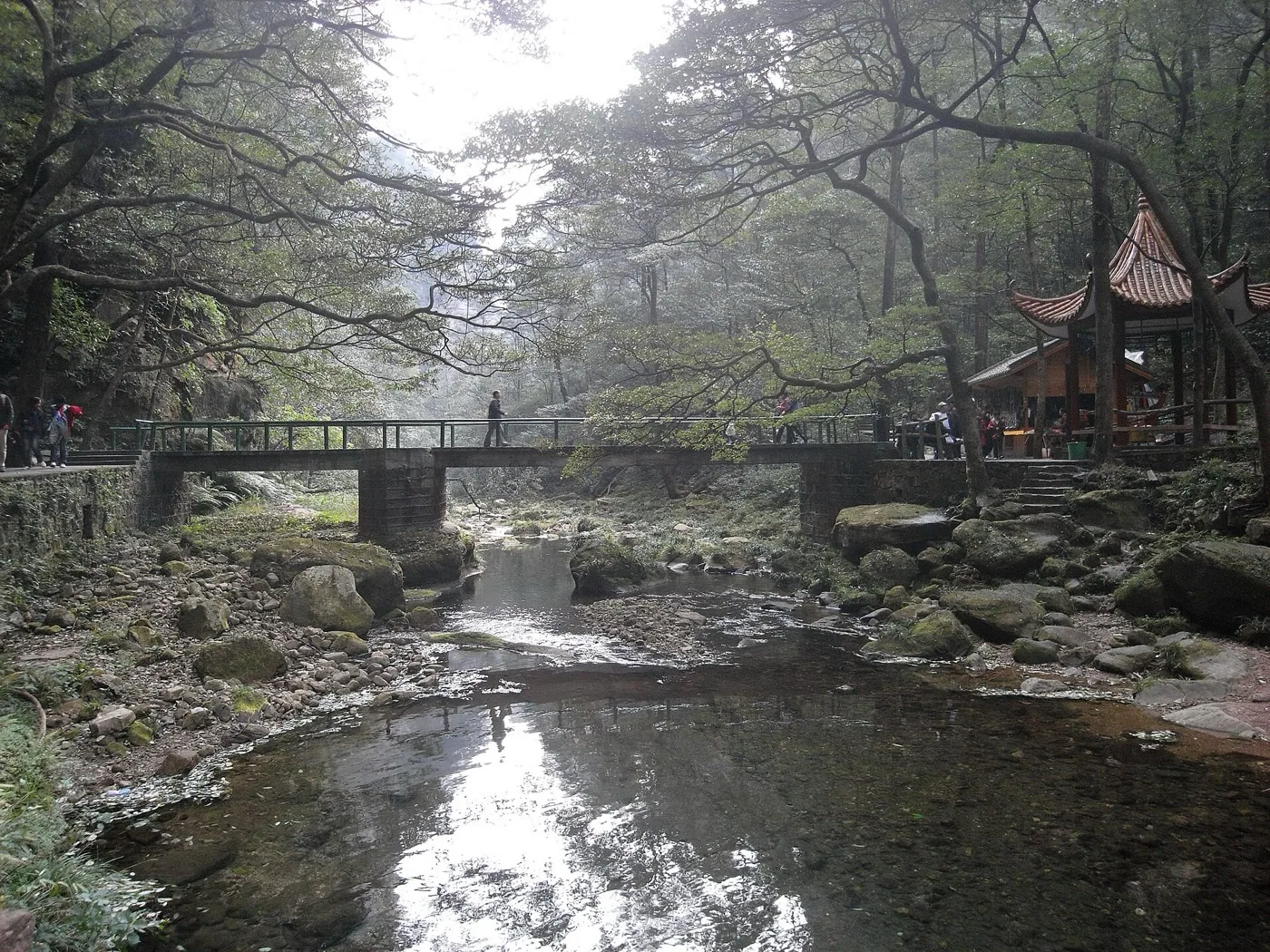
Rain here has a signature: it arrives decisively, dumps hard for twenty minutes to a couple of hours, and moves on — classic warm-season convection, most common from April to August and favouring afternoons in summer. All-day soakers happen, mostly in the spring plum-rain spells, but they are the exception. Build days that can absorb one wet interlude — a stream valley with rain gear, a long lunch, a museum hour — and the climate stops being an adversary.
Mist is the other resident. It forms in the valleys overnight, burns upward through the morning, and regathers after any rain; on perhaps half the days of the year some viewpoint somewhere is looking down on a cloud sea. This is the park at its best — the floating-mountain effect that made the scenery world-famous — and the reason locals smile at forecasts that make visitors groan. The finest hours in Zhangjiajie are very often the two hours after rain stops.
The park microclimate: why the summit is another country
Between your Wulingyuan hotel and the Tianzi terraces lies up to a kilometre of altitude, and the atmosphere charges for every metre: roughly six degrees colder per thousand metres before wind chill, plus exposed ridgelines where wind that the valley never felt cuts through a city jacket. A 30 °C city day can be a comfortable 22 °C on the plateau; a pleasant 15 °C autumn afternoon can be a raw 6 °C with wind on a summit rail at dusk.
Cloud plays by the same rules. The city can sit under flat grey while the plateaus float above a sunlit cloud sea — or the reverse, summits wrapped in fog while the valleys are clear and lovely. Never cancel a mountain morning because the view from your hotel window is grey: check, or ask someone on the mountain. Getting this call right is a daily part of our guides’ job.
What to pack, season by season
The packing list is short because the strategy is layers, not equipment: park days pass through valley heat, cableway chill and summit wind in a single afternoon, and the winning outfit is whatever can add or shed a layer in thirty seconds at a bus stop.
If you forget something, do not overpack out of fear — Zhangjiajie city and Wulingyuan both have outdoor shops, pharmacies and supermarkets, and ponchos appear for sale at every gate the moment rain starts.
- All year: broken-in walking shoes with real grip — wet sandstone and stone stairs are slick; leave smooth-soled sneakers at home
- All year: a genuinely waterproof rain jacket (umbrellas fail on windy ridges) and a small dry bag for phone and passport
- All year: one more warm layer than the city forecast suggests, for summits and cableway waits
- Spring & autumn: fleece or light down, quick-dry trousers, a warm hat from late October
- Summer: sun hat, sunscreen, electrolytes, and a change of shirt in the daypack — humidity soaks everything
- Winter: real insulation, gloves, warm hat, thermal base layer; compact ice grips if chasing snow days
- Always: passports (tickets are ID-linked), power bank, and tissues/hand sanitiser for park bathrooms
Weather-proofing your plan
The real weather skill is not packing — it is re-sequencing. Mist pinning the summits? That is a Golden Whip Stream and Baofeng Lake day, and the terraces move to tomorrow’s clearing. Storm forecast for the afternoon? The elevator goes first and the flat valley walk absorbs the rain hours. A thin overcast that tourists call disappointing? Photographers call it a soft-box; the guide calls it a Yangjiajie day.
Independent travellers can play this game with forecast apps and flexibility; a licensed private guide plays it with a decade of pattern-matching and live word from colleagues already on the mountain. It is one of the quietest but largest advantages of the service (¥1,000 per day for your whole group): in a place where the sky writes the schedule, you have someone who reads the sky for a living.
Frequently asked questions
Will rain ruin my Zhangjiajie trip?
Almost certainly not. Most rain comes in short bursts, the park is beautiful wet, and the clearing after rain is often the scenic peak of a whole trip. Only sustained storms — a few days a year — genuinely shut things down.
Do cable cars stop in rain?
Ordinary rain, no. High wind and lightning, yes — suspensions are usually brief and safety-driven. The enclosed Bailong Elevator typically keeps running when cableways pause.
How cold does it really get on the mountain in winter?
Plan for around −5 to 5 °C on the heights with wind chill below that. It is a damp cold that outperforms its numbers — proper insulation, gloves and a hat are not optional between December and February.
Is summer heat dangerous for hiking?
The plateau is usually a manageable 18–26 °C; the risk hours are midday in the valleys and city. Start early, hydrate, rest over noon and the season is entirely workable — families do it all summer.
Should I check air quality?
Zhangjiajie generally enjoys far cleaner air than China’s big cities — the park is a forest at altitude. Hazy days happen, mostly in winter, but air quality is rarely a reason to change plans.
Sources
Planning a Zhangjiajie trip?
Send us your dates and questions on WhatsApp. A licensed local guide answers personally — usually within a few hours (08:00–22:00 China time).